
The first time you push a stroller into Shinjuku or Umeda, the station feels like a small city with its own weather. The good news: Japan train stations with a stroller are far easier than they look. The big subways have elevator routes, staff will help, and strollers ride unfolded on most city trains. The trick is knowing which exit, which gate and which hour.

Here is how stations work in Tokyo, Osaka and Kyoto, plus Kyoto’s city buses and what to do with the bags. Rules come from the operators’ own sites, and we link them as we go.
Quick answer
- Elevators: Tokyo Metro, Osaka Metro and Kyoto City Subway all publish step-free information. Osaka Metro says all 133 of its stations have a step-free route.
- Gates: use the wide ticket gate. It is usually next to the staffed counter.
- Escalators: never with a child in the stroller. Take the elevator, or fold and ask for help.
- On the train: JR East, Tokyo Metro and Kyoto City Subway don’t ask you to fold. Look for the stroller mark.
- Rush hour: avoid weekday mornings and early evenings, and never squeeze onto a packed train.
- Kyoto City Bus: your child can stay in the stroller, strapped in place, but you may be asked to fold when it’s crowded.
- Lockers: coin lockers cost about ¥300 to ¥600. Big suitcases are better sent ahead.
Last checked: 1 November 2026
Japan train stations with a stroller: what to expect
Big city stations are built for crowds, and lately for strollers too. JNTO says most major stations have elevators. It also suggests the wheelchair-accessible option in map apps to plan routes (JNTO).
Three things surprise most families:
- The elevator is not always on the short route. Tokyo Metro warns that the elevator route is not always the shortest way to the platform, and elevators can be busy. Leave extra time (Tokyo Metro).
- Smaller towns have more stairs. JNTO notes that older infrastructure outside the big cities means more walking and stairs (JNTO).
- The stroller mark is your friend. You’ll see it on trains, buses and elevators. A crossed-out version marks places such as escalators where strollers are not allowed (Consumer Hotline for Tourists).
Elevators and which exit to use
Big stations have dozens of exits, and only some have an elevator to the street. Choosing the exit matters more than choosing the train.
- Tokyo Metro: the barrier-free station search shows elevators inside and outside the gates, plus “one-route” stations with a step-free path from street to platform.
- Osaka Metro: all 133 subway and New Tram stations have a step-free route, and so do transfers between its lines. The same page lists scheduled elevator inspection days (Osaka Metro). Check them before a big travel day.
- Kyoto City Subway: platforms have elevators to the station level, and families with strollers can use every train (Kyoto City Subway).
- JR West: most stations have elevators, but some don’t. Ask station staff for details (JR West FAQ).
Our routine is simple. Before leaving the hotel, look up the destination station and note the exit with the street elevator. A pattern we see in parent messages: coming up at the wrong exit costs more time than the whole train ride.
The wide ticket gate
Parents often ask whether a stroller fits through a normal ticket gate. Sometimes it does, until one wheel catches.
Use the wide gate instead. JNTO says the wider wheelchair-accessible gate is usually beside the staff counter (JNTO). Osaka Metro builds one gate wider than the rest for wheelchairs and large items. The Tokyo government says every Toei Subway station now has one wide gate (Tokyo Updates).
One small catch: at some stations the wide gate works in one direction only at rush hour. Hankyu’s Minami-ibaraki station map, for example, says its wide gates are entrance-only at peak times (Hankyu). If it beeps at you, the staff window is right there.
Escalators, stairs and asking station staff
The escalator rule is firm. Tokyo Metro says a stroller with a baby in it cannot go on the escalator, because it can tip or hit other passengers (Tokyo Metro).
When there is no elevator, ask. Tokyo Metro says station staff or security guards will help, for example by carrying the stroller at an escalator. JR West says to ask station staff if you need help on stairs (JR West support FAQ). All its staffed stations also offer a phone interpreting service (JR West FAQ).
A useful phrase: “ErebÄ“tÄ wa doko desu ka?” (“Where is the elevator?”).
On the train: free spaces and the platform gap
You can usually roll straight on.
- JR East: strollers don’t need to be folded. Some trains have an open area for wheelchairs and strollers. Otherwise, keep it at your feet and take care when the train is crowded (JR East).
- Tokyo Metro: no folding needed. Trains have free spaces marked with the stroller mark, and you share them with other passengers (Tokyo Metro).
- JR West: commuter trains show the stroller mark next to the wheelchair space (JR West).
Watch the platform. Tokyo Metro notes that some platforms slope, so set the brake and keep a hand on the stroller. In Osaka, Midosuji Line trains have different floor levels, so board carefully (Osaka Metro).
Arriving by Shinkansen with suitcases? Our guide to Narita or Haneda to Kyoto with kids covers the luggage racks and what children pay.
Rush hour: when to fold, wait or walk
JNTO’s family guide says weekday rush hours peak from about 7 to 10 am and 5 to 7 pm, with the morning worse. Don’t squeeze onto a packed train; the next one is minutes away. On a crowded train, fold the stroller and use a baby carrier (JNTO).
In the Kyoto, Osaka and Kobe areas, some JR West trains have women-only cars. Boys up to elementary school age may ride in them too (JR West FAQ). Handy for Mum. Dad gets the next car and the moral high ground.
When your toddler refuses the stroller
It happens to everyone. A pattern we see often: a one-year-old in Osaka who won’t stay in the stroller, wants to run everywhere, and makes every crowd feel twice as big.
What helps us:
- Carry a carrier. JNTO notes that Japanese parents switch between strollers and carriers depending on the day (JNTO). Then the empty stroller becomes a luggage trolley.
- Plan the busy transfer for after the nap. A sleeping toddler is the most stroller-friendly toddler.
- Give them a job. Spot the stroller mark, press the elevator button, count the trains.
Which stroller works in Japan?
We get versions of this question every week. Is a Nuna travel stroller fine in Japan? Which travel stroller for a six-month-old? We don’t review brands, and any compact model can work. Test yours at home:
- Can you fold it with one hand while holding a child?
- Can one adult carry it up a staircase?
- Does it fit at your feet on a train and inside a small elevator?
GO TOKYO, Tokyo’s official guide, suggests a foldable umbrella-type stroller or a baby carrier for crowded transport (GO TOKYO). Check fold size and weight on the maker’s own site. Twin strollers need a quick check: JNTO says some buses don’t accept them (JNTO).
Kyoto city buses with a stroller
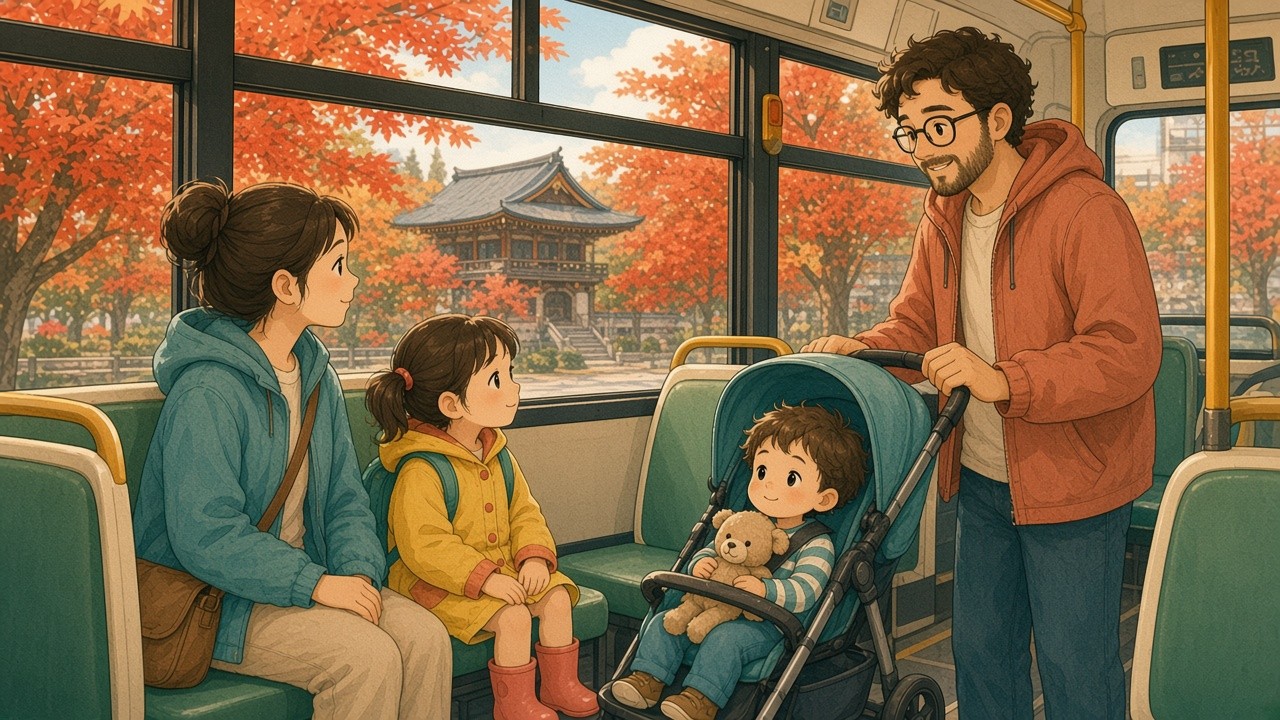
Kyoto runs on buses, and they are busy. The rules are clear, though. Kyoto City Bus lets your child stay in the stroller, including two-seat strollers. When the bus is crowded, you may be asked to fold it (Kyoto City Transportation Bureau).
How it works:
- Board through the middle or rear door and exit at the front. On tourist express buses it’s the other way round.
- Park in the stroller space, facing the back of the bus, and lock the wheels.
- Fasten your child’s harness, then attach the bus’s safety strap to the stroller.
- Hold the stroller for the whole ride (Kyoto City Bus).
Every bus shows a stroller mark on the front, next to the destination display. Our tip: use the subway for the long legs, since every train takes strollers, and the bus for the last stretch.
If the bus ride doubles as nap time, our guide to sleeping with a baby in Japan helps you protect the night as well.
Coin lockers and luggage
Coin lockers are at most stations and tourist facilities. JNTO says they cost about ¥300 to ¥600 depending on size, many take IC cards, and they fill up fast in busy places (JNTO).
The better plan is a stroller plus one bag. Send suitcases ahead with a Hands-Free Travel counter or your hotel’s front desk (JNTO). Pack the snacks where you can reach them, because a station is where hunger strikes. Our guide to Japan with a selective eater lists the convenience-store snacks that work for fussy kids.
FAQ: Japan train stations with a stroller
Do I need to fold the stroller on Japanese trains?
Usually not. JR East, Tokyo Metro and Kyoto City Subway allow unfolded strollers. Fold it on a crowded train and always on an escalator.
Do all stations have elevators?
Most big-city ones do. Osaka Metro has a step-free route at every station, while JR West says some of its stations have no elevator. Ask station staff for help.
Where is the wide ticket gate?
Usually next to the staffed window. It’s wider than the other gates and works for strollers and large bags.
Can I take a stroller on a Kyoto city bus?
Yes. Your child can stay in it, strapped into the stroller space. You may be asked to fold it when the bus is crowded.
Stations without the sweat
Japan train stations with a stroller reward a little homework: the right exit, the wide gate and a quiet hour. Do that, and the station becomes the easy part of the day.
Planning your first trip? Get our free Japan with Kids: The First-Trip Survival Checklist, a printable 10-page list for the weeks before you fly.
Stay with us
Planning your first trip? Get our free Japan with Kids: The First-Trip Survival Checklist, a printable 10-page list for the weeks before you fly.